
Simple locates, $200–$400
Short runs, decent access, leak confirmed and marked without drama.
The water bill knows something you don’t. Somewhere under a slab or behind a wall in Castle Hill, a pipe is quietly feeding the ground, and finding it with instruments instead of a jackhammer is the difference between lifting three tiles and gutting a bathroom. We locate to centimetres, then repair through one deliberate hole.
A hidden leak cannot help giving itself away three times over. Escaping water under pressure sings at frequencies acoustic gear can chase along a pipe run; it changes the temperature of whatever it soaks, which thermal imaging paints in false colour through wall sheeting and slab surfaces; and it bleeds pressure from whichever isolated section of pipework it lives on, which a gauge catches cold. One signal suggests; three signals triangulate.
That triangulation is what you are actually buying. Where the readings converge, we mark the floor, and in Castle Hill’s renovated homes, where pipework wanders in ways no council plan ever recorded, that mark routinely sits metres from where anyone would have started digging on instinct. The difference between those two points is the difference between lifting three tiles and re-doing a bathroom.


Many original brick homes still run earthenware pipework that cracks as the Hills’ reactive clay soil moves through wet and dry spells.
Reactive ground swells and shrinks with moisture, and it does not do it evenly across a property. Anything rigid crossing that ground is worked at its weakest point until something opens, usually a joint, usually slowly.
It is why leaks in this kind of country tend to appear after the seasons turn rather than during a single event, and why the same property can produce a second one years later a few metres from the first.
Failed waterproofing in a shower is the single most frequent source of inter-lot water damage in strata, and it rarely presents as a leak at all, it presents as a damp patch on a neighbour's ceiling months after the membrane gave up.
Newer developments around Castle Towers and the Metro share drainage runs, so one blockage needs a camera and the right access to clear properly.
It is worth ruling in or out early because it is a building repair rather than a plumbing one, and the process for approving and funding it is different. Flood testing the recess is inexpensive and definitive.
Castle Hill’s leafy, established streets and mature gardens send roots hunting into old pipe joints, a top cause of recurring blockages here.
On sloping ground, water leaving a pipe travels along whatever path is easiest until something stops it. By the time it appears it can be metres from the failure, several properties away, and always further down.
So the damp patch is a starting point, not a destination. We work uphill from it with correlation equipment rather than digging where the evidence happens to be visible.
A cracked earthenware line leaking into its own trench washes out the bedding supporting it. Losing support, the pipe sags; sagging, it holds water; holding water, it collects solids and eventually blocks.
Which is why a drain that has begun to block regularly and a drain that is leaking are frequently the same drain at different stages. Finding it early is considerably cheaper than finding it once it has collapsed.
A leak beneath a concrete slab is the one everybody dreads, and the dread is mostly about the excavation rather than the plumbing.
Which is exactly why locating it precisely is worth paying for. Acoustic listening, thermal imaging and tracer gas will normally place a slab leak inside a small area, the difference between cutting one section of floor and exploring several.
Castle Hill sits high in Sydney’s Hills District (postcode 2154), a leafy, established suburb bordering Baulkham Hills, Cherrybrook, West Pennant Hills and Kellyville. From older brick homes on generous blocks to the newer townhouses around Castle Towers and the Metro, its drains see everything, and we know the local ground well.
The technical question and the financial question have different answers, and both need settling. Pipework serving only your lot is yours; risers, mains and common-property lines belong to the owners corporation.
A leak detection report that names the line, the lot and the direction of travel is what turns a dispute into a decision. That is what we write, because a description of where the water appeared settles nothing.
Short runs, decent access, leak confirmed and marked without drama.
First hour with the full instrument kit, acoustic, thermal, pressure, on a typical concealed leak.
Beyond the first hour: extended runs, tight access, multiple suspects to eliminate.
Deep slab lines and multi-storey mysteries at the top of Sydney's range.
Priced off exactly what the detection proved, fixed before it starts, same crew, same visit, no second call-out.
Weigh it against the alternative: exploratory demolition starts at more than detection costs, and it starts in the wrong place. Figures here are indicative of the 2026 Sydney market rather than a quote from us, you get your own number as a fixed price before any work starts.

The meter test, done properly, plus your bills and history. If the evidence says no supply leak, you hear that, not a bill for finding nothing.
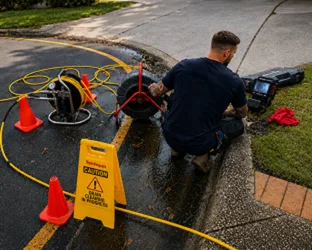
Pressure-testing the pipework in sections, hot against cold, line by line, corners the leak into one run before any listening starts.

Acoustic gear and thermal imaging along the guilty run until the readings converge. The mark on the floor is where the repair happens, centimetres, not metres.

Access exactly at the mark, the failed section repaired, pressure-tested, closed up. If the line's condition says reroute instead of repair, you get both numbers first.
That is a leak, and it is not fixing itself. Book the detection before it surfaces through something expensive.
Instruments, evidence, one precise repair: and a bill that goes back to normal.

Leave your details and our local Castle Hill team will call you back fast.